

Best Home Sauna for Recovery: 2026 Top Picks
Table of Contents
- Best Home Sauna for Recovery: Quick Comparison
- What to Look for in a Home Sauna Buying Guide
-
Best Infrared Sauna for Home Recovery: Top Picks
- 1. Lumin Infrared Sauna Two, Best Overall
- 2. Blisspod Bergen, Best Full-Spectrum Recovery
- 3. Fjordheim Solo, Best Budget Entry
- 4. Lumin Infrared Sauna One, Best for Couples in Small Spaces
- 5. Lumin Infrared Sauna Three, Best for Families
- 6. Eldvik 2-Person Outdoor Infrared Sauna, Best Outdoor Recovery Setup
- 7. 2000W Canadian Hemlock Double Outdoor, Best Value Outdoor
- 8. Finnmark FD-4 Trinity, Best Hybrid Heat
- 9. Mande MW20 Outdoor ThermoWood, Best for Groups
- 10. Thermasol Fortis Aspen, Best Premium Traditional
- Infrared vs. Traditional Sauna: Which Helps Recovery More?
- How Long to Stay in a Sauna After a Workout
- Safety, Evidence, and Total Cost of Ownership
- Conclusion: Choosing Your Best Home Sauna for Recovery
- Frequently Asked Questions
Last Updated: October 5, 2026
Best Home Sauna for Recovery: Quick Comparison
The best home sauna for recovery depends on one thing: how well it fits your actual routine. At Heaven 417, we understand the importance of a sauna that seamlessly integrates into your routine.
So we built this guide around recovery first. Not cabinetry. Not prestige.
Quick Picks:
- Best Overall: Lumin Infrared Sauna Two, balanced size, far-infrared heat, and daily usability
- Best for Full-Spectrum Recovery: Blisspod Bergen, near, mid, and far infrared plus red light therapy
- Best for Contrast Therapy: Eldvik 2-Person Outdoor Infrared Sauna, built for year-round outdoor use
- Best Budget Entry: Fjordheim Solo Infrared Sauna, one-person footprint, far-infrared heat
- Best for Traditional Heat: Mande MW20 Outdoor ThermoWood Sauna, seats 5-6
A home sauna is a personal heat-therapy room installed on your property, using infrared panels or a traditional heater to raise your body temperature for recovery and relaxation.

Cleveland Clinic overview of sauna health effects
| Sauna | Type | Capacity | Price | Best For |
|---|---|---|---|---|
| Lumin Infrared Sauna Two | Far-infrared | 2 people | $7,999 | Best overall |
| Blisspod Bergen | Full-spectrum + red light | 2 people | $4,999 | Full-spectrum recovery |
| Finnmark FD-4 Trinity | Infrared + steam + red light | 2 people | $8,299.97 | Hybrid heat |
| Eldvik 2-Person Outdoor | Far-infrared | 2 people | $5,999 | Outdoor contrast therapy |
| Lumin Infrared Sauna One | Far-infrared | 1-2 people | $6,999 | Small spaces |
| Fjordheim Solo | Far-infrared | 1 person | $3,999 | Budget entry |
| Lumin Infrared Sauna Three | Far-infrared | 3 people | $9,999 | Families |
| 2000W Hemlock Double Outdoor | Far-infrared | 2+ people | $2,990.95 | Lowest cost |
| Mande MW20 Outdoor | Traditional ThermoWood | 5-6 people | $8,999 | Social sessions |
| Thermasol Fortis Aspen | Traditional, 9kW Harvia | 3-4 people | $36,619 | Premium traditional |
What to Look for in a Home Sauna Buying Guide
Most guides rank saunas by wattage and wood species. That's backwards for recovery.
1. Usable temperature, not peak temperature. A heater's maximum rating tells you little.
2. Warm-up time. This is the biggest predictor of daily use.
**3.
**4.
**5.
6. Placement and infrastructure. Indoor units need ventilation and, depending on the heater, a dedicated circuit.
7. Total cost of ownership. Sticker price is the smallest number in the equation.
8. Evidence-aware expectations. No sauna is a treatment.
Cleveland Clinic overview of sauna health effects
Best Infrared Sauna for Home Recovery: Top Picks
Infrared wins for most recovery routines because it delivers deep heat without the punishing air temperature. Here are the picks we'd put in a recovery-focused home.
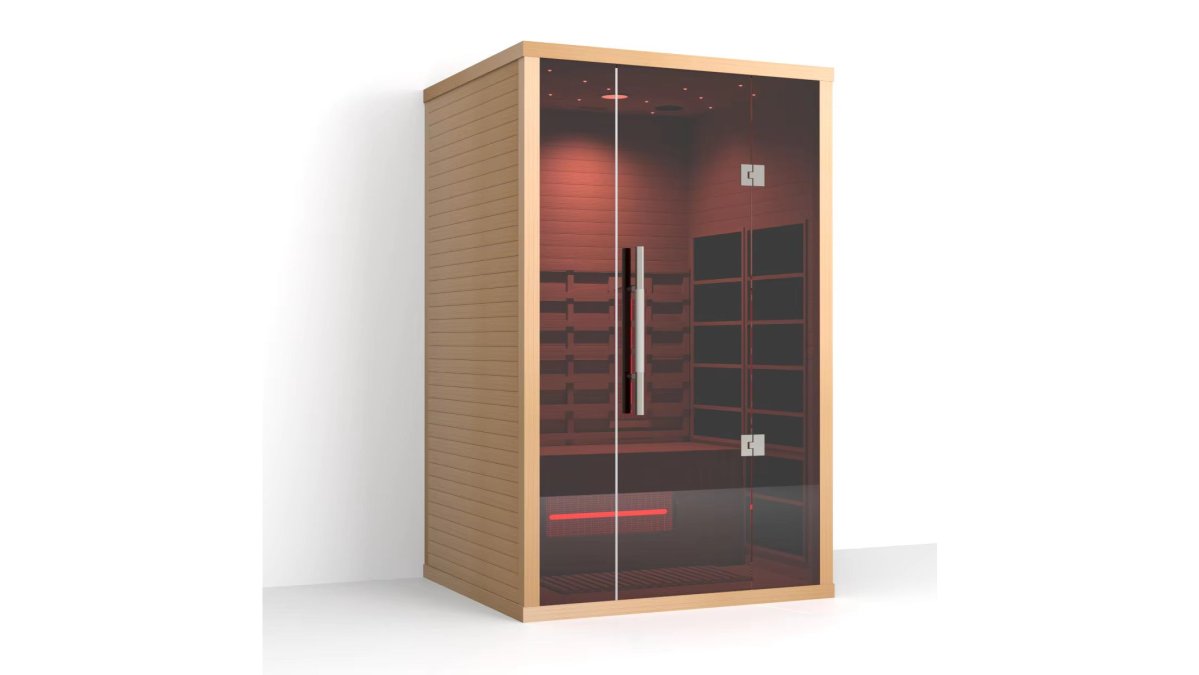
1. Lumin Infrared Sauna Two, Best Overall
The Lumin Two is a highly recommended sauna, and for good reason: it fits.
Pros: Compact enough for apartments, far-infrared heat for recovery, plug-in 110V/220V compatibility Cons: One-year warranty is shorter than premium traditional units, no steam option
2. Blisspod Bergen, Best Full-Spectrum Recovery
Full-spectrum means near, mid, and far infrared in one cabin. The Bergen adds a large red light therapy panel positioned directly in front of the body, plus chromotherapy lighting. For skin, sleep, and muscle recovery in a single session, this unit covers all three.
Pros: Full-spectrum coverage, dedicated red light panel, dual inside/outside control panels Cons: Two-person capacity limits family use, requires a certified electrician for the 120V/20A circuit
3. Fjordheim Solo, Best Budget Entry
One person, one footprint, one clear purpose. The Fjordheim Solo brings far-infrared heat into apartments and small wellness rooms at the lowest price in our lineup. Digital controls, solid wood construction, and easy assembly make it a low-risk first sauna.
Pros: Lowest entry price, fits tight spaces, indoor or covered outdoor placement Cons: Single-person only, basic feature set
4. Lumin Infrared Sauna One, Best for Couples in Small Spaces
The Lumin One sits between the Solo and the Two. It handles one or two people in a 47 by 39 inch footprint with far-infrared heating and a computer control panel.
Pros: Fits two people in a small footprint, plug-and-play setup, Hemlock construction Cons: Tighter interior than the Lumin Two, one-year warranty
5. Lumin Infrared Sauna Three, Best for Families
Three-person capacity without moving to a traditional cabin. The Lumin Three uses the same far-infrared technology as its smaller siblings with a 47 by 60 inch interior.
Pros: Room for three, ventilation window, simple control panel Cons: Heaviest indoor unit in the lineup, needs a dedicated space
6. Eldvik 2-Person Outdoor Infrared Sauna, Best Outdoor Recovery Setup
Canadian Red Cedar construction gives the Eldvik natural resistance to moisture and decay, making year-round outdoor use realistic. Low-EMF far-infrared panels deliver the same deep heat as indoor units. For contrast therapy, this sauna pairs well with a cold plunge.
Pros: Cedar handles weather, low-EMF panels, integrated LED lighting Cons: Requires a level outdoor pad, one-year limited warranty
7. 2000W Canadian Hemlock Double Outdoor, Best Value Outdoor
Eight infrared plates, detachable beauty lamp, oxygen bar, and cup holders at the lowest price in the outdoor category. It's a straightforward, functional cabin.
Blisspod | Bergen | Full Spectrum Ultimate Indoor Sauna | Red Light Therapy | 2 →
Pros: Lowest outdoor price, spacious seating, efficient heating Cons: Fewer premium finishes, basic control set
8. Finnmark FD-4 Trinity, Best Hybrid Heat
Infrared, traditional steam, and red light therapy in one cabin. The 1.9kW heater provides authentic humid heat, while the 192-diode red light panel targets skin and collagen.
Pros: Three heat modes, antimicrobial Western Canadian Cedar interior, Spectrum Plus heaters Cons: Highest price of the two-person infrared options, more complex install
9. Mande MW20 Outdoor ThermoWood, Best for Groups
ThermoWood construction resists moisture and holds its shape through seasonal swings. With room for five or six, the MW20 turns a sauna into a social space.
Pros: Seats 5-6, thermally modified timber, tempered glass doors Cons: Large footprint, not a solo recovery tool
10. Thermasol Fortis Aspen, Best Premium Traditional
A 9kW Harvia heater, thermally modified Aspen interior, and multi-layer insulation make the Fortis the most capable traditional sauna in our catalog. Optional WiFi control and RGB light therapy round it out.
Pros: Powerful 9kW heater, superior insulation, year-round outdoor use Cons: Highest price by a wide margin, professional installation strongly advised
Infrared vs. Traditional Sauna: Which Helps Recovery More?
Neither type is universally better. The right choice depends on your recovery goal, heat tolerance, and how often you'll actually use it.
How each type heats you. Infrared cabins warm your body directly through radiant panels, so the air stays cooler while tissue absorbs heat.
Recovery outcomes by use case. Here's what each type tends to suit:
- Post-workout muscle recovery: Infrared is the more common pick because lower air temperatures allow longer, more comfortable sessions and less cardiovascular strain. Many people find 20-30 minutes at a moderate infrared temperature easier to tolerate than a hot traditional room.
- General relaxation and sleep routine: Either type works. The deciding factor is usually which one you'll use consistently in the evening without dreading the heat.
- Contrast therapy: Traditional or infrared both pair with a cold plunge. The practical question is whether the cabin sits close enough to the plunge for a smooth hot-cold cycle.
- Social sessions: Traditional cabins scale larger and hold heat well with multiple bodies inside, which is why group saunas tend to be traditional.
- Skin and light-therapy interest: Full-spectrum infrared units with red light panels are marketed for skin and collagen support. Treat these claims as promising but not settled.
Safety and heat-use guidance. Heat stress is real, and a closed cabin is a poor place to feel faint.
- Hydrate before and after. Replace electrolytes if you sweat heavily.
- Start at 10 minutes if you're new, and build toward 15-30 minutes over several sessions.
- Never combine sauna use with alcohol.
- Skip sauna use if you're pregnant, have uncontrolled blood pressure, or take medications that affect sweating or blood pressure.
- Exit immediately if you feel dizzy, nauseated, or light-headed.
- Consult a clinician first if you have a heart condition, are on multiple medications, or aren't sure how your body handles heat.
The practical split:
- Choose infrared for post-workout recovery, daily use, lower heat tolerance, and smaller spaces.
- Choose traditional for the classic high-heat experience, social sessions, and those who prefer intense dry or humid heat.
- Choose hybrid if you want both modes without buying two cabins.
Mayo Clinic guidance on sauna and heat therapy safety
How Long to Stay in a Sauna After a Workout
Stay 15 to 20 minutes after a workout, and hydrate before you go in. That's the range most recovery protocols settle on. Longer isn't automatically better: heat stress accumulates, and the marginal recovery benefit flattens while dehydration risk climbs.
A simple post-workout sequence:
- Cool down and rehydrate for 10-15 minutes after training
- Shower and dry off before entering
- Sit for 15-20 minutes at a comfortable temperature
- Exit and cool down gradually
- Rehydrate with electrolytes
Safety, Evidence, and Total Cost of Ownership
Sauna research is promising but not settled. Studies link regular heat exposure to cardiovascular and recovery benefits, yet much of the evidence is observational rather than controlled. Treat sauna use as a supportive habit, not a treatment.
Be skeptical of any claim that a sauna "detoxifies" you or replaces medical care. Sweating removes water and electrolytes; your liver and kidneys handle the rest.
Total cost of ownership goes beyond the sticker price:
| Cost Factor | Typical Consideration |
|---|---|
| Unit price | $2,990 to $36,619 across our lineup |
| Electrical work | Dedicated circuit, licensed electrician |
| Delivery | Pallet shipping, curb or inside placement |
| Foundation | Level pad for outdoor units |
| Ongoing | Filters, wood care, energy use |
Conclusion: Choosing Your Best Home Sauna for Recovery
The hard part isn't picking a sauna. It's picking one that you'll consistently use for your recovery.
Match the unit to your space first, your recovery goal second, and your budget third. The Lumin Two covers most households. The Blisspod Bergen covers full-spectrum recovery.

At Heaven 417, we're an authorized dealer of cedar saunas and contrast therapy systems, and we walk you through selection, installation, and setup.
Start with the sauna that fits your routine, and the recovery follows.
CDC information on heat-related illness prevention
Frequently Asked Questions
Does a sauna actually help with recovery?
Heat therapy raises blood flow and can ease the muscle soreness that follows hard training. Many athletes use a home sauna after workouts to relax tight tissue and support circulation. Results vary by person and session length, so treat it as one part of a broader recovery routine that includes sleep, hydration, and protein. If you have a heart condition or low blood pressure, check with a doctor before regular use.
Is an infrared or traditional sauna better for recovery?
Infrared saunas heat the body directly at lower air temperatures, which many people find easier to tolerate for longer sessions. Traditional saunas use higher heat and steam, which some users prefer for deep sweating. For recovery, the best infrared sauna for home use often wins on comfort and warm-up time, while traditional saunas suit those who want intense heat. Both can support relaxation and post-workout recovery.
How long should you use a sauna after a workout?
Most guidance points to 15 to 20 minutes per session, starting shorter at 10 minutes if you are new to sauna use. Wait until your heart rate has settled after training, hydrate before and after, and exit if you feel dizzy. For a home sauna, a 15-minute session three to four times per week is a practical starting point for recovery support.
What should you look for in a home sauna for recovery?
Prioritize heating type, capacity, construction materials, and controls. Low-EMF infrared panels and full-spectrum heaters are common in recovery-focused models. Check the temperature range, warm-up time, and warranty. For a home sauna buying guide, also factor in installation requirements, space, and total cost of ownership, including any electrical work needed for 240V units.
Recovery equipment only works when it matches your daily life, and that's the gap most buyers fall into. Heaven 417 helps you close it with hand-selected cedar saunas and contrast therapy systems, guidance from selection through installation, and financing available at checkout. Get started with Heaven 417 and build a recovery routine you'll actually keep.