

Cedar Sauna Heater Panel Lifespan: How Long It Lasts
Table of Contents
- How Long Does a Cedar Sauna Heater Panel Last?
- What Affects Sauna Heater Lifespan
- Cedar Sauna Maintenance: Protecting the Wood and Heater Panel
- Failure Symptoms: When Your Heater Panel Is Failing
- Sauna Panel Replacement and Repair: What to Expect
- Choosing a Cedar Sauna Built to Last
- Frequently Asked Questions
Last Updated: October 15, 2026
How Long Does a Cedar Sauna Heater Panel Last?
The average cedar sauna heater panel lifespan runs 8 to 15 years for a traditional electric heater and 10 to 20 years for a well-built infrared panel.

Homeowners worry about their cedar walls. The wood almost always outlasts the heater.
A few things shorten that service life fast:
- Running the sauna daily instead of a few times a week
- Poor ventilation that traps moisture around the electrical components
- Skipping inspections until something stops working
Below, we break down what actually drives heater lifespan, how to spot a failing panel, and when to repair versus replace.
What Affects Sauna Heater Lifespan
Sauna heater lifespan depends on three things: how often you run it, how well you maintain it, and how well it was built. Get those right and a heater can serve for well over a decade.
Heat Cycles, Humidity, and Operating Conditions
Every session is a heat cycle. The heating element expands when hot and contracts as it cools.
Humidity speeds this up. A traditional steam sauna pushes moisture into the air, and that moisture finds its way into the control panel and wiring.
Ventilation matters more than most owners realize. A sauna that can't breathe holds damp air against the electrical components.
Traditional vs. Infrared: How Heater Type Changes Durability
Traditional and infrared heaters age in completely different ways.
Traditional electric heaters use exposed heating elements and stones. The elements take direct heat stress and tend to fail first, often in the 8-15 year window.
Infrared saunas use sealed panels with no exposed element. Fewer moving parts and lower surface temperatures mean less wear, so infrared panels commonly last 10-20 years.
| Heater Type | Typical Lifespan | Main Failure Point | Best For |
|---|---|---|---|
| Traditional electric | 8-15 years | Heating element | High-heat steam sessions |
| Infrared panel | 10-20 years | Control panel | Gentle, frequent use |
| Wood-burning | 10-20+ years | Stove body | Off-grid and outdoor builds |
Cedar Sauna Maintenance: Protecting the Wood and Heater Panel
Regular cedar sauna maintenance is what separates a sauna that lasts 20 years from one that struggles at 10. But before you can maintain the right thing, you have to know which panel you're looking at, because "cedar sauna heater panel" gets used for three different components, and they age on completely different clocks.

What "Heater Panel" Actually Means
- Heater housing or shroud panel, the metal or cedar-faced enclosure that surrounds the heating elements and stones. This is the part most people mean when they say "heater panel." It takes radiant heat and splash exposure directly.
- Control panel, the circuit board, thermostat, and timer assembly, usually mounted on or near the heater or on an exterior wall. It is electronics, not wood, and it fails from moisture and voltage cycling, not from heat alone.
- Cedar wall panel behind or beside the heater, the tongue-and-groove cedar cladding. This is structural and decorative wood, not an electrical component. It ages from heat and humidity, but it does not "fail" the way a control board does.
Conflating these three is a common mistake. A homeowner replaces a cedar wall panel thinking the heater is shot, or replaces a heater when only the control board has failed.
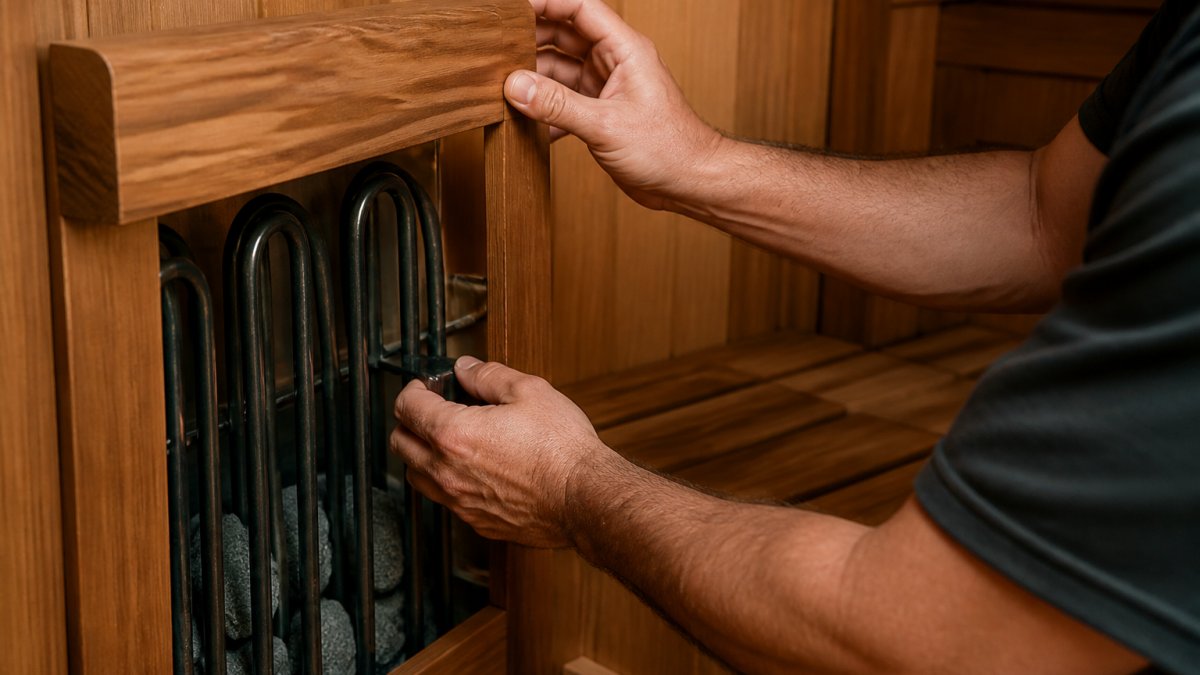
How Heat and Moisture Actually Affect Cedar Near a Heater
Cedar is chosen for saunas because its oils resist rot and it moves less than many softwoods under humidity swings. That does not make it immune.
Over hundreds of cycles, that shows up as:
- Resin bleed, amber streaks near the heater where heat has pushed oils to the surface. Cosmetic, not structural.
- Checking and small cracks, fine surface splits along the grain. Normal in cedar; a problem only if cracks open enough to expose fasteners or wiring.
- Cupping or warping, usually a ventilation problem, not a cedar problem. Trapped moisture on one face of the board causes it to move unevenly.
What cedar does not do is protect the electronics behind it. Heat and humidity pass through wood. If the control panel is mounted on cedar, that cedar is a thermal bridge, not a barrier.
A Maintenance Routine That Matches the Component
- Monthly: Wipe benches and the heater housing with a damp cloth. Do not soak cedar. Vacuum dust and debris off the stones and element area once the heater is fully cool.
- Twice a year: Inspect the control panel for condensation, discoloration, or insect activity. Check that ventilation intake and exhaust are unobstructed. Look at the cedar behind the heater for resin bleed or darkening that could indicate overheating.
- Annually: Have a qualified electrician verify connections and grounding at the heater. Re-oil cedar sparingly, a light coat, not a seal.
A common mistake is sealing cedar too heavily. Cedar needs to breathe. Film-forming finishes trap moisture against the wood and can push humidity toward the heater panel and control board. If you want to protect cedar near a heater, use a breathable sauna-specific oil and keep the finish thin.
Proper care does double duty: it protects the cedar and keeps heat and moisture away from the electrical parts. But maintenance cannot rescue a panel that was mis-specified for the room in the first place, which is why the next section matters.
Failure Symptoms: When Your Heater Panel Is Failing
A failing heater panel usually warns you before it dies. Catching the signs early can save the whole unit.
Watch for these symptoms:
Custom 4-Person Luxury Canadian Red Cedar Outdoor Steam Sauna With Heater →
- Uneven heat, with hot and cold spots in the room
- A heater that takes much longer to reach temperature
- Cracking, discoloration, or warping on the panel surface
Two or more of these together usually means the panel is near the end of its service life. A burning smell or tripped breaker is a safety issue. Stop using the sauna and have it checked.
Sauna Panel Replacement and Repair: What to Expect
Sauna panel replacement is a planned cost, not an emergency, if you catch the signs early. The decision comes down to four questions: which component failed, whether parts are still available, what the warranty covers, and whether the work is safe for you to do yourself.
Step 1: Identify the Failed Component
Match the symptom to the part before you price anything.
| Symptom | Likely Component | Typical Action |
|---|---|---|
| No heat, but controls light up | Heating element | Replace element |
| Controls dead or erratic | Control panel / circuit board | Replace board or control assembly |
| Uneven heat, hot spots | Element or stone bed | Replace element, restack stones |
| Rust or corrosion on housing | Heater housing panel | Replace housing or full heater |
| Breaker trips repeatedly | Wiring, element, or board | Stop use; electrician diagnosis |
A heater with a solid body and one failed part is usually a repair. A heater with corrosion through the housing, multiple failed components, or a discontinued control board is usually a replacement.
Step 2: Check Parts Availability and Warranty First
This is the step most owners skip, and it's the one that changes the math.
- Parts availability: Many heater manufacturers support current models with replacement elements and control boards for years, but older or discontinued models may have no OEM parts. Aftermarket elements exist, but fit and wattage must match the original specification. A mismatched element can overheat the housing or underheat the room.
- Warranty coverage: Residential sauna heaters commonly carry multi-year coverage, and it is common for the heating element and control components to be covered on different terms than the housing or the cedar structure. Read the warranty document, not the marketing page. Coverage often requires professional installation and may be voided by unauthorized repairs.
- Receipt and registration: If you bought the sauna as part of a package, the heater warranty may be registered to the original purchaser. Keep documentation.
Step 3: Decide Repair vs. Replace
A practical framework:
- Repair if the heater body is structurally sound, the failed part is available, and the unit is within its expected service window (roughly 8-15 years for a traditional electric heater, 10-20 for infrared).
- Replace the heater if the housing is corroded, the control board is discontinued, or two or more major components have failed within a short period. At that point, labor and parts approach the cost of a new unit.
- Replace the cedar wall panel separately if the wood is charred, cracked through, or has pulled away from fasteners. This is a carpentry repair, not an electrical one, and it should be done before the new heater goes in.
Step 4: Installation and Safety Requirements
Heater replacement is not a plug-and-swap job in most installations.
- Electrical: Sauna heaters draw high current and typically require a dedicated circuit sized to the heater's rating. Wiring, breaker size, and grounding must match the manufacturer's specification and local electrical code. If you are not confident working inside a panel, hire a licensed electrician.
- Clearances: Manufacturers publish minimum clearances to combustible surfaces, including cedar. Reinstalling a heater closer to the wall than specified is a fire risk, even if it fits.
- Ventilation: Confirm intake and exhaust are not blocked by the new unit's footprint.
What to Expect on Cost and Timing
Replacement elements and control boards are generally the lowest-cost path and can often be swapped in a single service visit. A full heater replacement costs more because it includes the unit, labor, and sometimes a circuit check.
If your sauna is older and the cedar is still in great shape, a new heater panel is a smart, low-cost fix. The wood outlasts the electronics almost every time, which is exactly why it pays to diagnose the component before you replace the sauna.
Choosing a Cedar Sauna Built to Last
The best way to avoid early heater problems is to start with a sauna built from quality materials. That's where Heaven 417 comes in.
As an authorized dealer, we hand-select cedar saunas and contrast therapy systems built for daily use and long-term enjoyment. Every unit uses premium cedar and quality heating components, so the structure and the heater are matched for durability.

Our team supports you from selection through installation. That matters for heater lifespan, because correct wiring and ventilation are set up right the first time.
A few options worth a look:
- The Custom 4-Person Luxury Canadian Red Cedar Outdoor Steam Sauna pairs aromatic cedar with a heater and stones for a full traditional setup.
- The Auris One Luxury Outdoor Cedar Sauna is a compact 1-2 person build with electric or wood-burning options and a 5-year warranty.
- The Auris Two Luxury Outdoor Cedar Sauna fits 3-4 people and comes with the same 5-year warranty.
For buyers who want to pair heat with cold, our contrast therapy systems are built to work alongside these saunas for a complete recovery routine.
Frequently Asked Questions
How long do cedar sauna panels last?
Cedar sauna panels typically last 10 to 15 years with proper care, though some well-maintained panels can reach 20 years. Factors like usage frequency, humidity control, and ventilation play a major role. Panels in outdoor saunas face more weather exposure and may need attention sooner. Regular inspections and cleaning help you catch wear early and extend the panel's service life.
Does sauna heat damage cedar wood over time?
Cedar handles heat well because it resists warping and moisture damage naturally. However, repeated heat cycles combined with high humidity can cause gradual wear, including minor cracking and color fading. Proper ventilation between sessions and periodic treatment of the wood help slow this process. Cedar's natural oils provide protection, but they diminish over years of use, so maintenance matters.
How do you know when sauna panels need replacing?
Signs that sauna panels need replacement include deep cracks, soft or spongy wood, visible mold that returns after cleaning, and panels that feel loose or show separation at the seams. If the heater panel itself shows corrosion, discolored wiring, or fails to reach temperature, it may need replacement too. Address these signs early to avoid electrical safety risks and further structural damage.
Can cedar sauna panels be repaired or replaced individually?
Yes, individual cedar panels can often be repaired or replaced without rebuilding the entire sauna. Minor cracks can be filled, and surface damage can be sanded. If a panel is structurally compromised, a carpenter or sauna technician can swap it out. For heater panels specifically, always disconnect power and follow the manufacturer's guidance before any repair or replacement work.
A cedar sauna is a long-term investment, and the heater panel is the one part you'll likely replace first. Choosing quality equipment and maintaining it well is what keeps that day far off. Heaven 417 offers hand-selected cedar saunas, guidance from selection through installation, and easy monthly payments. Get started with Heaven 417 and build a sauna that performs for years.