

Cedar Sauna vs Redwood Outdoors: Best Wood for Sauna
Table of Contents
- Cedar Sauna vs Redwood Outdoors: Head-to-Head Comparison
- What Is the Best Wood for an Outdoor Sauna?
- Durability, Weather Resistance, and Long-Term Aging
- Heat Retention, Thermal Stability, and Scent Profile
- Redwood Outdoors vs Sun Home Saunas: What Buyers Should Know
- Sauna Maintenance Tips for Cedar and Redwood Cabins
- Cost, Foundation Prep, and Climate-Specific Picks
- Conclusion
- Frequently Asked Questions
Last Updated: September 23, 2026
Cedar Sauna vs Redwood Outdoors: Head-to-Head Comparison
Walk into any backyard wellness showroom and you will hear the same two names: cedar and redwood. The cedar sauna is the default recommendation for outdoor builds, while redwood is the premium alternative. Both are excellent and both cost real money, so the choice deserves more than a sales pitch.

What Is the Best Wood for an Outdoor Sauna?
The best wood for an outdoor sauna is a naturally rot-resistant softwood with low shrinkage: cedar and redwood both qualify, and cedar is the stronger all-around pick for most climates. Both are lightweight, dimensionally stable, and pleasant to touch when heated.
Cedar: Aromatic Oils, Dimensional Stability, and Rot Resistance
Cedar is the standard for a reason: its aromatic oils act as a natural preservative, and its low density keeps it dimensionally stable through repeated heating and cooling.
- Rot resistance: Naturally resistant without chemical treatment
- Dimensional stability: Low shrinkage and warping compared to denser woods
- Aroma: Distinct, resinous scent that intensifies when heated
- Weight: Light enough for simpler foundation requirements
- Workability: Cuts and fits cleanly, which keeps assembly tolerances tight
Redwood: Natural Decay Resistance and Color Longevity
Redwood's advantage is tannins, which make the heartwood naturally resistant to decay and insects and hold its rich reddish-brown tone longer than cedar outdoors.
Durability, Weather Resistance, and Long-Term Aging
Cedar and redwood both deliver strong rot and weather resistance, but they age on different clocks. Understanding those clocks is the difference between a cabin that looks intentional at year five and one that looks neglected.
What actually happens to each species outdoors
Cedar (Western red cedar and the aromatic red cedar used in most kits): The extractives that make cedar rot-resistant, thujaplicins and other natural oils, are also what give it color. As those extractives leach out under rain and UV, the surface lightens. The typical progression most builders observe:
-
Year 1: Color deepens slightly as the surface oxidizes; the resinous scent is strongest.
-
Year 2-3: A shift toward tan, then a mottled gray-tan as UV breaks down surface lignin.
-
Year 4-5: Even silver-gray on sun-exposed faces; shaded faces lag by a year or more.
-
Year 5+: Gray is stable and cosmetic only, the wood underneath is still sound if the roof and base are doing their job.
-
Year 1-2: Minimal change; the red-brown tone holds.
-
Year 3-5: Gradual deepening toward a chocolate-brown, with gray beginning on the most exposed faces.
-
Year 5+: A weathered brown-gray that reads as 'aged wood' rather than 'faded wood.'
Surface checking, grain raise, and the failure points that actually matter
Both species check, small surface cracks that follow the grain, as the outer face dries faster than the core. Cedar checks slightly less aggressively because its lower density means less moisture differential across the thickness; redwood heartwood checks similarly but with finer cracks.
Neither species fails from checking. Cabins fail from:
Auris One Luxury Outdoor Cedar Sauna →
- Water trapped at the base. The bottom plate and the first course of siding are where rot starts. A 1-2 inch gap between the wood and any concrete or gravel surface, plus a capillary break, prevents wicking.
- Roof and flashing leaks. A small leak at the roof-wall junction will rot a cedar wall as fast as a pine one. Inspect flashing every spring.
- Fastener corrosion. Stainless or hot-dip galvanized fasteners only. A rusted screw is a water path into the wood.
- Sealed interiors. Trapping moisture inside a heated cabin causes warping and interior rot regardless of species.
The aging comparison, side by side
| Factor | Cedar | Redwood |
|---|---|---|
| Color after 3-5 years | Silver-gray, even tone | Retains reddish-brown longer, then brown-gray |
| Color after 10 years | Stable gray | Stable brown-gray |
| Surface checking | Minor, slow | Minor, similar |
| Rot resistance | High, oil-based | High, tannin-based |
| Dent resistance | Moderate | Lower in softer grades |
| Scent retention | Strong, persists for years | Fades within months once dry |
| Response to exterior sealer | Takes stain and sealer evenly | Takes sealer well; color shift less dramatic |
What to look at on a five-year-old cabin
If you can visit a display cabin that has been outdoors for several seasons, check three things: the bottom six inches of the exterior wall (softness or dark staining means water is sitting there), the underside of the roof overhang (delamination or dark streaks), and the door threshold (the highest-wear joint on any sauna). Those three spots tell you more about build quality than the species label on the brochure.
Heat Retention, Thermal Stability, and Scent Profile
Cedar and redwood perform almost identically on heat retention because both are low-density softwoods with similar insulation value. The bigger variables are wall thickness, insulation behind the panels, and heater sizing, not the species.
Redwood Outdoors vs Sun Home Saunas: What Buyers Should Know
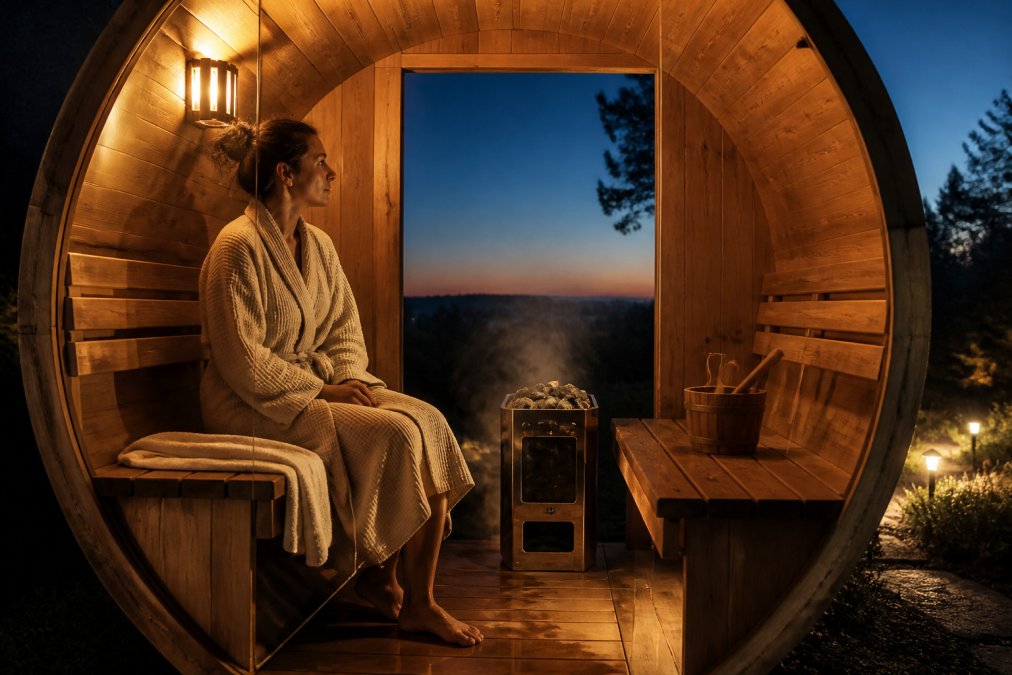
Buyers comparing Redwood Outdoors vs Sun Home Saunas are really comparing two things: barrel-style kits and cabin-style builds. Barrel saunas heat faster and use less material; cabin saunas offer more usable space and better bench ergonomics.
| Model | Capacity | Material | Price | Warranty |
|---|---|---|---|---|
| Auris One | 1-2 people | Natural red cedar | $18,499 | 5 years |
| Auris Two | 3-4 people | Natural red cedar | $23,499 | 5 years |
| Eldvik Infrared | 2 people | Canadian red cedar | $5,999 | 1 year limited |
Buyers who want a cedar cabin sized to their household and supported from selection through installation, rather than a kit shipped to the driveway.
Sauna Maintenance Tips for Cedar and Redwood Cabins
Sauna maintenance tips for both species follow the same rhythm: keep water off the exterior, keep the interior dry between sessions, and inspect the base twice a year. Cedar needs more attention to color; redwood needs more care against dents.
- Vacuum or sweep benches weekly to remove dust and skin oils
- Leave the door open for 20-30 minutes after each session to dry the interior
- Inspect the roof and flashing every spring and fall
- Check the foundation for standing water after heavy rain
- Reapply exterior sealant every 2-3 years on cedar, 3-4 on redwood
- Tighten heater mountings and check the door seal annually
Cost, Foundation Prep, and Climate-Specific Picks
Foundation preparation is where most outdoor sauna projects go over budget, and the step buyers underestimate most. A sauna needs a level, well-drained base: a reinforced concrete pad, compacted gravel with a vapor barrier, or a framed deck rated for the cabin's weight. The species you choose changes which base is appropriate.
How wood choice drives foundation requirements
Cedar is roughly 20-25% lighter than redwood for the same dimensions, and that weight difference cascades into the base:
- Cedar cabin: A compacted gravel pad with a vapor barrier and a pressure-treated sill plate is often sufficient for smaller cabins. The lighter dead load means a simple deck rated for the cabin's footprint works in many yards.
- Redwood cabin: The higher density means more load per square foot, which pushes more builds toward a reinforced concrete pad or a pier-and-beam foundation with proper footings. On soft or expansive soils, this is not optional.
Climate-specific picks, with the mechanism behind each
Humid, rainy regions (Southeast, Pacific Northwest, Gulf Coast): Cedar's oil-based resistance handles constant moisture well because the oils sit in the cell walls and slow water uptake. The priority is not the species, it is roof overhang, drainage away from the base, and a vapor barrier under the floor. Redwood also performs well, but the cost premium buys color retention rather than rot resistance, a cosmetic win where the real enemy is standing water.
Cost-benefit, in plain terms
Redwood typically runs 20-40% more than cedar for equivalent dimensions in sauna-grade lumber. That premium buys slower color fade and slightly higher natural decay resistance in the heartwood. It does not buy a longer-lasting cabin if the foundation and roof are done correctly, both species will outlast their owners when built well.
The species matters less than the build. A cedar cabin on a bad foundation will fail before a redwood cabin on a good one. Budget for site prep first, then choose your wood based on your climate and how much you care about color retention.
Conclusion
Choosing between cedar and redwood is a real decision, but not the hardest one in your build. Site prep, heater sizing, and honest maintenance habits decide whether your sauna lasts a decade or two.
Frequently Asked Questions
Is cedar or redwood better for an outdoor sauna?
Both resist rot and handle moisture well. Cedar brings aromatic oils, lighter weight, and better dimensional stability, so it resists warping and shrinking across humid summers and freezing winters. Redwood offers strong natural decay resistance and holds its color longer. For most backyards, cedar sauna kits win on scent, thermal insulation value, and price, while redwood suits buyers who want minimal color change over decades.
What type of wood is best for an outdoor sauna?
The best wood for an outdoor sauna combines natural decay resistance, low shrinkage, and stable grain. Cedar and redwood lead because their tannins and oils fight rot without chemical treatment. Kiln-dried lumber matters too: it limits moisture content, which reduces warping once the heater cycles daily. Avoid untreated softwoods with poor rot resistance, since they break down fast in wet climates.
Does redwood hold up better than cedar outdoors?
Redwood edges ahead on natural decay resistance and color retention, which matters in damp, rainy regions. Cedar holds up well too and resists warping and shrinking more predictably because of its lower density and stable grain. In practice, both last decades with basic care. The deciding factor is usually upkeep habits and climate, not the species alone.
What maintenance does a cedar or redwood sauna need?
Sauna maintenance tips for both woods look similar: rinse interior benches after heavy sweat sessions, keep the exterior sealed or oiled every one to two years, and clear snow or debris off the roof. Check for warping near the door and heater, and tighten hardware seasonally. Cedar may darken to silver-gray faster; redwood keeps its tone longer. Neither needs harsh chemicals.
How much does a cedar outdoor sauna cost?
Pricing depends on size and heater type. A 1-2 person cedar cabin like the Auris One Luxury Outdoor Cedar Sauna runs $18,499, while the 3-4 person Auris Two Luxury Outdoor Cedar Sauna is $23,499. A wood-burning heater add-on costs about $1,500, and professional installation is a $4,000 flat fee. Infrared options start lower, with the Eldvik 2-Person Outdoor Infrared Sauna at $5,999.